
Sahib Aquaponics : What shall we grow today?
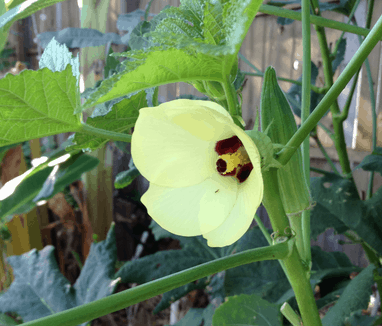
Okra – aka “Ladies Fingers”, “Kingombo”, “Gumbo” and “Bhindi”
During the last two years or so, I have found that you can grow almost any vegetable and plants that you choose to in Aquaponics. You may need to adapt the grow beds and practice hybrid aquaponics as I do to increase your range of products. I have successfully grown broccoli, carrots, eggplants, daikon and radishes, fennel, fruit trees, kohlrabi, herbs, okra, onions, pumpkins, marrows, gourds, tomatoes, strawberries, peppers – hot & sweet just to name some. I have also seen others grow corn and some even sweet potatoes via wicking beds. One really needs to expand their horizon and realize that there are really very few items that will not grow well in Aquaponics systems. Yes there are a few items that are just not cost effective at present such as grains and rice. There is research being done on these products and I am sure that very soon these too will become economic to grow via Aquaponics means.
Today I am going to write about one of my wife’s favorite items that we grow at Sahib Aquaponics, Okra. We call it by the Hindi/Urdu Name Bhindi. This much loved vegetable is a favorite of many and is usually grown in hot weather, one of the few that does not wilt and die as the temperatures rise. The green pods when cooked release a “goo” or slime which is considered by many to be beneficial to health. Okra can be eaten raw, boiled, fried, sautéed, stir fried, stuffed, and included in stews. The leaves can also be eaten, usually in salads.
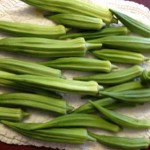
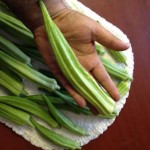
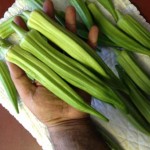
Okra plants can grow up to 9 feet tall and with uncut Okra fruit, can weigh a lot hence they are not good candidates for “raft” Aquaponics. They are better suited to deep media beds preferably containing 3/4inch rocks. Grow them direct from seed and avoid the transplant shock. Although I have grown a hybrid variety from saved seeds, I do prefer to grow the “Clemson Spineless”. Each plant may only have one or two Okra pods maturing at any one time and you should pick these often. Try to pick the pods when they are 3 to 5 inches, although I must confess that in Aquaponics, they tend to grow that almost every day! If I forget to pick them for a couple of days, they have grown to 10 to 11 inches tall and fat as a cucumber. Hat is not always a good idea as letting them grow to a larger size tends to make them woody and lose their taste. My Aquaponically grown Okra are honestly the very best tasting “Bhindi” that I have ever eaten. When planting Okra you do need a lot of room as you should plant a number of plants if you would like to be able to harvest enough pods for a meal once or twice a week.
You can eat Okra right off the plants or cook them in numerous ways. They can also be frozen or pickled. You can cut them in ¼” to ½” pieces and stir fry then with onions and spices, or coat them with seasoned corn meal and deep fry them. They can be stuffed with spices, other stuffing or even cooked ground meat and then stir fried. Gumbo is another way to eat Okra. In order to get the maximum health benefits of Okra, try to avoid over cooking it and avoid deep frying. Okra is an excellent source of many nutrients such as Vitamin A, Vitamin B6, Vitamin C, Calcium, Copper, Iron, Potassium, Magnesium, Niacin, Zinc as well as containing Folic Acid. It is considered a weight loss food with optimum health benefits. The fibers found in Okra are supposed to help stabilize bold sugar, improve the functioning of the intestinal tract and help provide the body with good bacteria for the digestive system.
I have found the following web article on Okra to be helpful and am sharing it with you http://www.neurophys.wisc.edu/ravi/okra/ It also contains some recipes. I will request my daughter to include some Indian Bhindi recipes on her Blog www.lovelaughmirch.com
Okra!
“Is it profitable?”
In Pure Economics 101 terms, it all depends! If you live in very hot climates like Central Florida, your choice of produce to grow for market is limited during the hot summer. If you have the space and the appropriate Aquaponics set-up, growing Okra during the hot season and provide you with a stream of income that was non-existent during this hot period of the year. If you had a fifty foot long by 4 foot wide media filled grow bed area, so 200 sq. ft. space, you should be able to plant at least 120 plants – spacing them 12” to 15” apart. Once they start to produce fruit, you should be able to harvest approx. 30lbs to 40lbs weekly. Organic Okra, if available (and you know as you will hopefully educate your customer that Aquaponically grown is much superior), was selling for $2.99-$3.50/lb at the local farmer’s market. Say if you have a 20 week production harvest that could result in $3,000.00 plus additional income. Not as much as one could earn if growing tomatoes or green leafy veggies. However you could not grow them in this hot climate without some serious climate control environment! By the way, you can still grow basil, mint, hot peppers and gourds / melons in the open space of the media grow beds thus further add to you farm income.
As to whether it is “profitable” from a health point of you, this is going to be your decision. Let me help you a little. Growing them by aquaponics means ensures that you are assured the best natural taste. As I was quoted in the recent article in Cornell University Small farm Program Newsletter – the Urban Gardening section “This was a far superior way to grow it locally, grow it naturally, without having to resort to harmful pesticides and fertilizers and such, because if I did, my fish would die.” I have listed just some of the health benefits of Okra. Do you know, this is one vegetable that is so valued in Indian cuisine that had resulted in India becoming the largest grower of Okra. Ayurvedic medicine states numerous health benefits of eating Okra. Here is another link detailing information on Okra as a “Body Cleanser” http://www.ehow.com/about_5471466_information-okra-body-cleanser.html






In future “What shall we grow today?” article’s I will write about some of the vegetables mentioned above as well some other less known such as Bitter Melon (Kerela), Fenugreek (Methi), Malabar Spinach and Moringa (Drumsticks). Please let me know if there are any vegetables you would like to grow in Aquaponics and know more about them.
http://nutritiondata.self.com/facts/vegetables-and-vegetable-products/2497/2
God bless
 Best Western Orlando East Inn & Suites
 Crestwood Suites of Orlando-UCF Area
 Days Inn N Orlando/Casselberry
 Park Plaza Hotel
 Thurston House Bed and Breakfast